

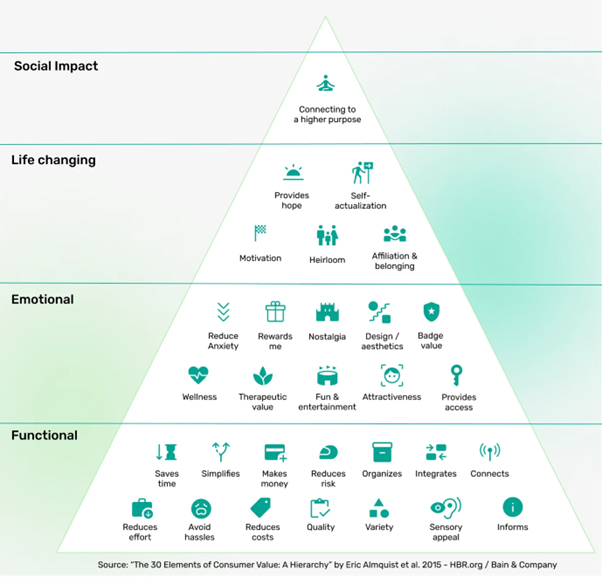
An organization that is able to continuously innovate and add value has a competitive edge. But what kind of values should you consider? You could, of course, think of price, quality, or specific specifications. While these functional aspects are important, subjective and personal considerations also play a role. Fortunately, research has been conducted on the values that matter in the consumer market. This research by Bain Company offers tools for building a strong consumer proposition. The 30 value elements are divided into a pyramid with five categories.
This blog is about products or services aimed at consumers, do you have a product or service for the business market? Then check out this blog.
1. Functional value as the starting point of value
The base of the pyramid is about added value that is functional. What problems are you solving for the consumer? Functional elements include time savings, low price and ease of use. Companies like Amazon and Bol.com have a strong focus on these functional elements, offering customers a quick, easy and cost-effective experience. This type of value appeals to a wide audience because it provides immediate benefits in everyday life.
2. Emotional values to connect with your target audience
Consumers do not buy based solely on functionality; emotions often play an equally large role. Emotional value includes, for example, reducing stress, increasing enjoyment, or promoting self-expression. A brand that is able to make an emotional connection creates loyal customers. For example, consider brands such as Apple or Mercedes, which provide not only functional products, but also a sense of quality and prestige. Or Nintendo that capitalizes on the feeling of the past (nostalgia as value) with the Classic Mini Nes, by re-releasing their old game console including the most popular games.
3. Life-changing value that allows your clients to be the best they can be.
Life-changing elements in a product or service are values that help customers improve their lives. For example, your product can help them improve their health, boost their personal development or contribute to the customer’s self-confidence. An example of this is Fitbit. Fitbit helps consumers achieve their fitness goals, which has a positive impact on their well-being and self-esteem. If you can provide that for your customer, you are very valuable.
4. Social values that contribute to a greater good
More and more consumers value products and services that make a societal or impact contribution. Social impact elements, such as self-transcendence, where a product contributes to a greater good, are especially popular among younger generations. A brand like TOMS scores high on this element by donating a pair of shoes for every shoe sold to people who cannot afford the shoes themselves. Another example is Patagonia’s clothing. Not only do you wear good clothes, you also help build a greener future.
Conclusion: Build a value proposition that matters to your target audience
Which values are really of value depends on your target audience. So make sure you know what’s going on with your specific target audience. Because you cannot excel in all areas, it is essential to choose which elements you do much better than the competition. (Of course, make sure your product is good enough in the basics). So choose 1-3 elements that make your product unique. By addressing different needs, you can strengthen customer loyalty and stay ahead of the competition. On what elements will you differentiate your product or service?